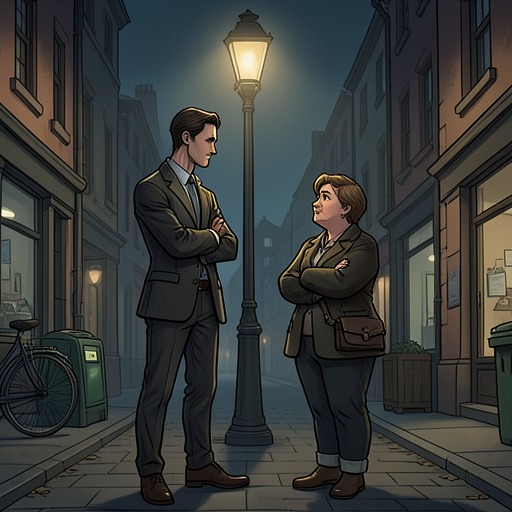
Emma ends her friendship with Dexter
One DayEmma Morley ends her friendship with Dexter Mayhew after an evening that turns a familiar bond into an explicit break. A failed dinner, a public fall, and a confrontation about Dexter’s drinking culminate in Emma’s decision that affection cannot sustain a friendship in which she no longer feels able to confide in him. Her farewell makes the loss especially stark: she still loves him, she says, but does not like him anymore.
Causes and Setting
The rupture grows out of an evening already going badly. When Emma’s fish arrives frozen, she tries to settle for chips, but Dexter insists on challenging the meal: he calls the waiter over, demands that the dish be removed from the bill, and argues that Emma should receive a replacement main course without charge. Emma no longer feels hungry and resists having another meal imposed on her, while Dexter insists that she must eat properly because the replacement is free. The dispute ends with her free green salad and two unwanted plates between them. The failed effort to make things right leaves Emma imagining that she could skip dessert and the party and go home to Ian Whitehead, whom she pictures as kind, considerate, and in love with her.
Dexter’s attempt at conversation deepens rather than repairs the estrangement. He sighs over his wine and repeats the disparaging idea that those who cannot do teach; Emma answers with an insult directed back at him. The exchange is not merely a disagreement about teaching. It exposes the contempt and irritation now shaping their conversation, while the wine in Dexter’s hand and the earlier failure of the evening make the gulf between them harder to ignore.
Public Humiliation and Confrontation
The argument becomes physical and public when Emma shoves the table away and jumps to her feet. Her movement sends Dexter’s wine into his lap; bottles and plates clatter as she grabs her bag and makes her way out of the restaurant. Diners watch. She tries to hold back tears, but her high heels cause her to stumble on the stairs and fall to her knees. The Cigarette Girl comes to her side and holds her elbow, offering help while Emma is exposed to the staring audience behind her.
Dexter follows, mopping his lap, placating the waiter, and then limping after Emma when a swinging door cracks him on the knee. He tries to explain the scene away as the result of their being a bit drunk. Emma rejects that explanation: in her view, he is the drunk one, and has been drunk or under the influence of something nearly every time she has seen him. She says she has forgotten what he is like sober, and identifies the habits that have made their encounters intolerable to her: his self-focused talk, his new friends, his repeated trips to the lavatory, and his apparent attention to better options beyond the person in front of him. She also dismisses his television work as no great achievement. The complaint is specific and accumulated; Emma presents the evening not as an isolated mistake but as another instance of a pattern she has endured for years.
The Friendship Is Named and Ended
Emma acknowledges that Dexter has been through a great deal, including his mother’s illness, and that she has tried to understand. But compassion does not restore their former closeness. She tells him that he is no longer the person she used to know and is no longer her friend. The decisive problem is her inability to talk to him about Ian: she believes that a friend should be someone she can confide in, and that without that possibility she cannot see the point of their friendship.
For a moment, the separation is expressed not through another accusation but through a small gesture. Emma takes two fingers of Dexter’s hand and squeezes them in her palm before suggesting that their friendship may simply be over. Dexter cannot answer. She tells him to go to his party and says he is free of her; he laughs with failing bravado and treats her words as though she were dumping him. Emma answers that she is, in a way. She would like the old Dexter back, but until then she asks him not to phone her anymore. Her request turns the argument into a boundary with a practical consequence: continued contact is no longer something she can accept on the terms they have been living.
Farewell and Aftermath
Dexter’s response is complicated by his memory of Emma holding and comforting him on the bathroom floor at his mother’s funeral. That recollection recalls a time when she was present in his grief, making the present break more than a quarrel over his conduct: he recognizes that he has treated their history as though it were nothing and has thrown it away. He follows Emma into the alley, still asking whether they are friends, while she stops without turning around. He knows she is crying, but her grief does not reverse her decision.
Emma then returns to him and pulls his face close to hers. For a brief moment Dexter thinks she may forgive him. Instead, she tells him that she loves him deeply and probably always will, but does not like him anymore. The distinction holds together the two truths on which the ending depends: enduring love remains, while trust and liking—the qualities needed for their friendship—have failed. She touches his cheek with her lips and leaves. Dexter is left alone in the back alley, trying to imagine what to do next.
Just before midnight, Ian returns to find Emma curled up on the sofa watching an old film. Her response to his question about Golden Boy closes the evening away from the public confrontation, but does not undo it. The break with Dexter is decisive in what Emma says and asks of him, even as the feeling she confesses makes clear that ending the friendship is not the same as ceasing to love him.